

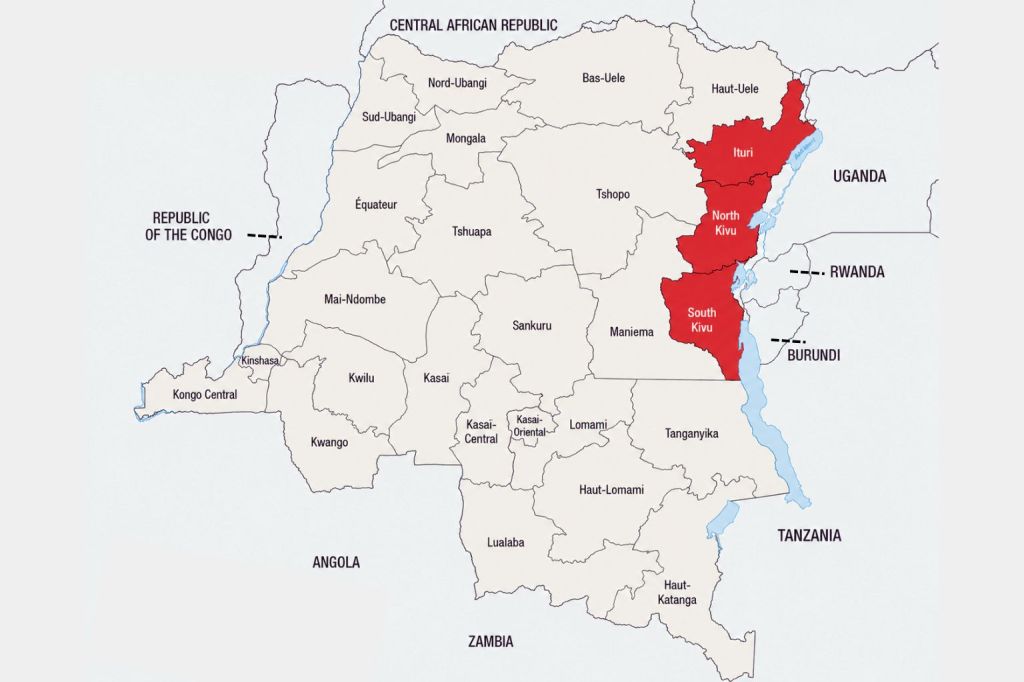
The current context in the DRC is characterised by complex and protracted armed conflicts in the east of the country, with regional dimensions – directly involving Uganda, Rwanda and Burundi. More than 100 local and foreign non-state armed groups are active in the provinces of Ituri, North Kivu and South Kivu. Some of the non-state armed groups fight against Government forces and others fight alongside Government forces.
In this context, countless cases of serious violations of International Humanitarian Law (IHL) – the law of armed conflict, and International Human Rights Law (IHRL) over the past 3 decades have been documented and reported, with civilian populations bearing the brunt, unfortunately.

Civilian protection challenges
Civilian protection challenges in the current DRC context include the following:
- A fragmented landscape of armed actors – that increases violence against civilians, weakens state authority, complicates peace negotiations, and contributes to recurring humanitarian crises, among other consequences.
- Weak and ineffective accountability mechanisms for serious violations of International Humanitarian Law and International Human Rights Law – contributing to making impunity the norm, which also contributes to the perpetuation of violence against civilians.
- Delays and apparent lack of good faith in the implementation of peace and ceasefire agreements between the DRC and Rwanda (the Washington peace accords), and between the DRC and AFC/M23 rebels (the Doha-Montreux peace process and agreements).
Civilian protection prospects
To improve the protection of civilian persons in the current context in the DRC,
- There should be increase of awareness of and training on applying International Humanitarian Law (IHL) – the law of armed conflict, and International Human Rights Law (IHRL) among the armed actors (as duty-bearers) and among civilian populations (as rights-holders), with a focus on the fourth Geneva Convention (GC IV) and the Additional Protocols I & II (AP I & II) that provide for the protection of civilians and other victims of armed conflicts. When rights-holders are aware of their rights, they are better able to claim them and enforce duty-bearers’ obligations to protect.
- There should be reinforcement of humanitarian advocacy & diplomacy for the respect of International Humanitarian Law and implementation of ceasefire and peace agreements.
- There should be reinforcement of community-based protection initiatives that allow civilian populations to contribute to ensuring their own protection against violence.
- There should be reinforcement of accountability mechanisms, including through effective implementation of transitional justice processes and mechanisms (judicial and non-judicial, official and non-official), using a holistic approach, aimed at dealing with root causes and consequences of the conflicts.
My latest blog posts/articles:

